
Interview with Amy’s Mom!
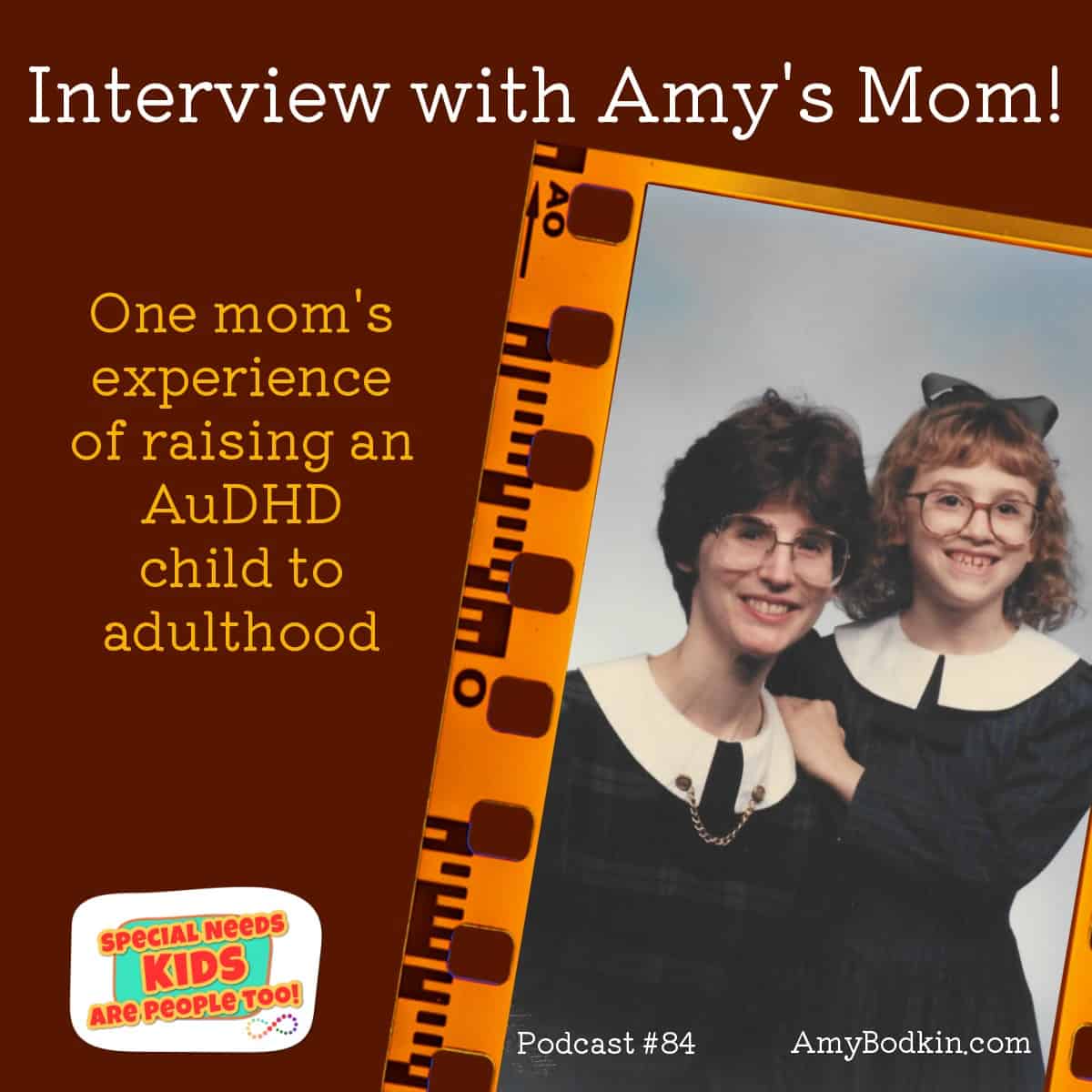
Today’s episode is an Interview with Amy’s Mom!
It is the first episode of our 6th season in which we will be talking about raising kids with disabilities from childhood to adulthood!
You get to hear about raising kids with disabilities all the time from Amy, but what does her mom have to say about what it was like raising Amy?
Join us as my mom shares some of the challenges, joys, and just her own unique perspective on raising me!
Scroll all the way to the bottom to see the Show Notes and to get a special offer from Amy Bodkin Consulting!
Listen to this Episode Here
Transcript
00:00:30.000 –> 00:00:48.000
Hi, I’m Amy Bodkin and welcome to another special episode of Special Needs Kids Are People Too. It has definitely been a few months since our last season, and I am excited about our upcoming season. Our upcoming season is going to be talking about
00:00:48.000 –> 00:01:00.000
transitioning from childhood to adulthood. And personally, I couldn’t think of a better way to kick that season off than to have a conversation with my mom
00:01:00.000 –> 00:01:14.000
I thought that might be very interesting to get to talk to my mom and hear some of her reflections on what it was like raising me from childhood to adulthood, some of the things that she found to be
00:01:14.000 –> 00:01:26.000
particularly difficult, things she wished she had done differently, things that worked really well, and just anything else that she noticed that might be particularly interesting. So, without further ado.
00:01:26.000 –> 00:01:29.000
This is my mother, Beth Frizell.
00:01:29.000 –> 00:01:32.000
Hi, Amy. I’m so glad to be here with you today.
00:01:32.000 –> 00:01:36.000
Thank you. So
00:01:36.000 –> 00:01:40.000
Since you’ve never gotten really to talk to my audience before.
00:01:40.000 –> 00:01:41.000
I want
00:01:41.000 –> 00:01:43.000
That’s right, but I have enjoyed your podcast.
00:01:43.000 –> 00:01:51.000
That’s true. I would love to just open us up with the question of
00:01:51.000 –> 00:01:56.000
What things did you think were particularly
00:01:56.000 –> 00:01:59.000
Relevant, interesting
00:01:59.000 –> 00:02:06.000
watching me grow up and raising me as opposed to all of my siblings
00:02:06.000 –> 00:02:13.000
Because I figured it’s different for me versus all of my siblings, since I’m the only one that has diagnoses
00:02:13.000 –> 00:02:27.000
Well, that’s true, but you were the first, so I didn’t have any prior experience. Autism, the way we see it today on the spectrum is nothing like what was known at the time
00:02:27.000 –> 00:02:34.000
And in one way it was kind of weird not having any knowledge, but in another way it wasn’t as overwhelming as it is today.
00:02:34.000 –> 00:02:35.000
That’s a good point.
00:02:35.000 –> 00:02:49.000
But we knew you were you, and we wanted you to be the best you.
00:02:49.000 –> 00:02:50.000
Oh, yeah.
00:02:50.000 –> 00:02:59.000
And so I think it was great parent training for me because I did the best I could with you and in each subsequent one, I discovered they were all different. They all had different needs and had to be addressed in different ways. One of my big things was always, if it doesn’t work, try something else. I did that with everybody
00:02:59.000 –> 00:03:00.000
Yes.
00:03:00.000 –> 00:03:04.000
And I don’t know if I got the idea from you, or if I was always that way. I have no idea.
00:03:04.000 –> 00:03:15.000
It’s hard to separate out what you would have done if I hadn’t been the first and had been somebody else versus what you learned from raising me.
00:03:15.000 –> 00:03:16.000
Yeah.
00:03:16.000 –> 00:03:25.000
Yeah, right. I have no idea. And also it prepared me for the future in addition to parenting the other children. By the way, there’s five of you. Then
00:03:25.000 –> 00:03:29.000
I also feel like when my in-laws got dementia, I
00:03:29.000 –> 00:03:37.000
I had a whole new level of being able to communicate with them and care for them that nobody else seemed to have. And I think that had something to do with it
00:03:37.000 –> 00:03:51.000
I think so too. I remember thinking when Mama ended up having dementia, it was right about the time that my kids were beginning to play bingo and they were still like in that
00:03:51.000 –> 00:04:02.000
sensory zone where they were more interested in sensory activities than they were in some of the more social activities.
00:04:02.000 –> 00:04:09.000
And I remember thinking at the time that dementia in a lot of ways is kind of like autism in reverse
00:04:09.000 –> 00:04:12.000
With autism, we start out
00:04:12.000 –> 00:04:14.000
very focused in on the sensory
00:04:14.000 –> 00:04:30.000
And then as we get older, we are more interested in like social cognitive activities. And then with dementia, we start out with being so heavily involved in social and cognitive activities, and then we move more towards the sensory
00:04:30.000 –> 00:04:33.000
As we experience more decline
00:04:33.000 –> 00:04:34.000
And
00:04:34.000 –> 00:04:35.000
in cognitive functioning.
00:04:35.000 –> 00:04:57.000
As my father-in-law got older, he had a different form of dementia. I was able to understand what he was trying to say. He tried so hard to communicate, and it reminds me of that Star Trek episode where the people talk in really strange terms because—I don’t know the word for it. You remember the episode I’m talking about?
00:04:57.000 –> 00:05:04.000
Okay, we’ll tell the viewers
00:05:04.000 –> 00:05:05.000
Yes.
00:05:05.000 –> 00:05:11.000
Oh, I know exactly what episode you’re talking about. You’re talking about—yeah, you’re talking about the episode based on the Gilgamesh myth: ‘Darmok and Jalad at Tanagra.’
00:05:11.000 –> 00:05:12.000
Yes.
00:05:12.000 –> 00:05:19.000
Yes.
00:05:19.000 –> 00:05:20.000
Right.
00:05:20.000 –> 00:05:23.000
I can’t remember the first words, but that’s what you’re talking about, where they use myth to communicate an idea, like Juliet on her balcony is supposed to represent maybe feelings of love, or maybe something else.
00:05:23.000 –> 00:05:39.000
Yeah, exactly. That episode reminded me of him trying so desperately to communicate with us. And I was able to listen to what he said and understand what he was trying to say, where everybody else thought, what’s he saying? We just don’t understand
00:05:39.000 –> 00:05:40.000
Yeah.
00:05:40.000 –> 00:05:43.000
And so I think you prepared me for all kinds of things.
00:05:43.000 –> 00:05:48.000
Well, in a way, it’s kind of like
00:05:48.000 –> 00:06:03.000
It’s kind of like advanced training and communication because you have to learn to communicate with somebody who sees the world differently than you, and then that prepares you to be able to communicate with so many other people because it expands your idea of what communication can be.
00:06:03.000 –> 00:06:06.000
Maybe.
00:06:06.000 –> 00:06:07.000
Oh
00:06:07.000 –> 00:06:26.000
Well, that brings us to the next thing I noticed. You talked more than everybody else. At times it was overwhelming for me because I’m kind of quiet, and listening as much as I needed to could be hard. But—
00:06:26.000 –> 00:06:27.000
That’s true.
00:06:27.000 –> 00:06:31.000
You just always talked more, but in a way that was really good because it helped me understand what your needs were, what needed to be addressed, and what you were thinking. That was so much easier than with your siblings, who never told me things.
00:06:31.000 –> 00:06:32.000
Yeah.
00:06:32.000 –> 00:06:40.000
Because, you know, you just… you just opened your mouth and everything came out, and, you know, it was a… it took a lot more time. Your dad and I both did a lot of listening.
00:06:40.000 –> 00:06:41.000
Yeah.
00:06:41.000 –> 00:06:51.000
But it was good, because that’s the way we helped process things and helped encourage you, and helped kind of direct you in ways that when you were off the Ritalin
00:06:51.000 –> 00:07:09.000
In high school, you had more social problems. You kept saying, I just don’t fit in, you know, and you kept complaining about all this, and we had to spend a lot of time doing that
00:07:09.000 –> 00:07:10.000
Right.
00:07:10.000 –> 00:07:19.000
Yeah, yeah, and I know, I think it was also a difficult time in general because like high school, junior high, like when all your hormones are changing, Ritalin doesn’t tend to be as effective anyways. And then you’re also dealing with like all of these changes that you’re experiencing personally and then everybody else around you is experiencing changes
00:07:19.000 –> 00:07:20.000
Right.
00:07:20.000 –> 00:07:31.000
So, yeah, that was a difficult time anyways.
00:07:31.000 –> 00:07:34.000
Yeah.
00:07:34.000 –> 00:07:35.000
Yeah.
00:07:35.000 –> 00:07:38.000
I did feel that having the Ritalin from age 8 to age 11 was good because it helped you know what focus felt like, so you knew what you were striving for. It might be hard to get there, but you knew what it was supposed to feel like.
00:07:38.000 –> 00:07:42.000
I do think it made a difference. I didn’t like it, but
00:07:42.000 –> 00:07:44.000
Oh, no
00:07:44.000 –> 00:07:47.000
Mostly because I felt like I wasn’t as much fun
00:07:47.000 –> 00:07:48.000
So.
00:07:48.000 –> 00:07:50.000
Well, it subdued your personality.
00:07:50.000 –> 00:08:03.000
I did not have as good of a time. And I don’t know, I think, I mean, you’re right, I definitely talked a lot more as a child. I still talk a lot. That’s why Amy has a podcast now.
00:08:03.000 –> 00:08:05.000
That’s right.
00:08:05.000 –> 00:08:16.000
But I think you’re also right, like, it really did help me learn to communicate with other people better, because I got a lot more practice.
00:08:16.000 –> 00:08:27.000
I do think that y’all did have to do a ton of listening because it takes a long time to get the words out that you want to get out in a way that makes sense to other people.
00:08:27.000 –> 00:08:41.000
Because you not only have to think about your own experiences and recognize what you’re experiencing and how that’s different from other people’s, but then also put that into words to where it makes sense to the person that you’re talking to.
00:08:41.000 –> 00:08:42.000
And that’s a lot of steps.
00:08:42.000 –> 00:08:44.000
Yes, it is
00:08:44.000 –> 00:08:48.000
Yeah. So, but I do think you’re right. I think that that
00:08:48.000 –> 00:08:56.000
did end up being kind of a bit of a bonus, and over the years, I’ve actually thought of it kind of like
00:08:56.000 –> 00:09:07.000
Sometimes I have trouble with my input, so people will be talking and I might not understand what they’re saying, or I might not be paying very close attention and completely miss what they’re saying
00:09:07.000 –> 00:09:16.000
But my output a lot of times makes up for my input. I talk enough that eventually I compensate for whatever I missed on the input.
00:09:16.000 –> 00:09:17.000
Okay, that makes good sense
00:09:17.000 –> 00:09:27.000
Yeah, so I’m like asking more clarifying questions so that I better understand what I took in when it didn’t quite make sense.
00:09:27.000 –> 00:09:28.000
Very good explanation.
00:09:28.000 –> 00:09:37.000
But it does make it very difficult on the people that are doing most of the listening. I’m finding that myself right now.
00:09:37.000 –> 00:09:45.000
I told Jessica the other night, I’m like, okay, I’ve focused as long as I can on the monologue, and I really need a break.
00:09:45.000 –> 00:09:47.000
So.
00:09:47.000 –> 00:09:54.000
She’s like, oh, right, sorry. She was very excited and in her zone and very excited about
00:09:54.000 –> 00:10:04.000
She was very excited about fashion and about voice acting and she’s gone completely in depth and I’m like
00:10:04.000 –> 00:10:11.000
I don’t even know what you’re talking about anymore. And I’m very impressed that you figured all this out because I have no idea what we’re talking about.
00:10:11.000 –> 00:10:12.000
So.
00:10:12.000 –> 00:10:13.000
I bet that’s interesting.
00:10:13.000 –> 00:10:17.000
It is interesting. It’s interesting being the parent when I was the kid first.
00:10:17.000 –> 00:10:20.000
But you’ve also got
00:10:20.000 –> 00:10:25.000
The same issue going on that she does and the two of you are interacting.
00:10:25.000 –> 00:10:30.000
Oh yeah, yeah, sometimes I’m very excited about something.
00:10:30.000 –> 00:10:41.000
And she can be a good listener. And then other times, she’s very excited about it, and I can be a good listener. But then we also have points where, like, and we’re done.
00:10:41.000 –> 00:10:45.000
So, what were some of the things that you felt were
00:10:45.000 –> 00:10:50.000
most difficult or overwhelming
00:10:50.000 –> 00:10:54.000
As I was growing up, because
00:10:54.000 –> 00:11:06.000
You didn’t have a lot of information to go on, which in some ways can be an advantage because there was less information to sift through. I mean, you guys got a pamphlet on ADHD from, like, the neurologist when I was a kid, and that’s it.
00:11:06.000 –> 00:11:12.000
Yes, it was a dinky little pamphlet with, like, three little tips in it.
00:11:12.000 –> 00:11:13.000
And
00:11:13.000 –> 00:11:17.000
That might have actually been one of the bigger challenges, not having information. Although
00:11:17.000 –> 00:11:19.000
Well, that’s true. We didn’t have Google
00:11:19.000 –> 00:11:20.000
No Google.
00:11:20.000 –> 00:11:21.000
Yeah.
00:11:21.000 –> 00:11:23.000
And limited book options.
00:11:23.000 –> 00:11:25.000
Yes, very much so.
00:11:25.000 –> 00:11:29.000
And you were limited to what books you could find in your library or your bookstore.
00:11:29.000 –> 00:11:40.000
The neurologist initially told me to look you in the eye when I was talking to you and to give you one step instructions
00:11:40.000 –> 00:11:45.000
No multiple things, one step instructions. And that really turned the corner for me
00:11:45.000 –> 00:11:52.000
And I think it’s something that carried through as you got older, because I had figured that out and we had gotten a basis.
00:11:52.000 –> 00:11:53.000
Yeah.
00:11:53.000 –> 00:11:58.000
And that made a big difference. If I had never figured that out, I think it would have been a whole lot more frustrating.
00:11:58.000 –> 00:12:00.000
Yeah, yeah
00:12:00.000 –> 00:12:07.000
Well, and in a way, you’re kind of slowing things down a little bit, because when you do one thing at a time
00:12:07.000 –> 00:12:26.000
It’s less overwhelming, because usually somebody who’s autistic is a bit overwhelmed by all of the things that either are inside their bodies or outside their bodies. And so processing sometimes is a little bit more slowed, so giving one thing at a time, and that would also account for working memory
00:12:26.000 –> 00:12:29.000
Because remembering things would also be a problem for some of us
00:12:29.000 –> 00:12:31.000
Yes, yes.
00:12:31.000 –> 00:12:37.000
And that was definitely one of the bigger problems I had was working memory. I had trouble remembering
00:12:37.000 –> 00:12:40.000
Math facts, how to spell
00:12:40.000 –> 00:12:44.000
Yeah, right. Once we got past that phase, things did get a lot better.
00:12:44.000 –> 00:12:45.000
Yes.
00:12:45.000 –> 00:12:50.000
Working memory picked up. You used it and we worked hard. It took a lot of time.
00:12:50.000 –> 00:12:51.000
It did
00:12:51.000 –> 00:12:54.000
But you got where you could manage it better.
00:12:54.000 –> 00:12:55.000
Yeah.
00:12:55.000 –> 00:13:01.000
And then, you know, there’s always note-taking, you know. I’m one of these that has sticky notes everywhere to remind me stuff.
00:13:01.000 –> 00:13:10.000
Yeah, and when I was in college, I used to record all of my lectures on one of those teeny tiny tape recorders
00:13:10.000 –> 00:13:15.000
So that I could take my notes later and pay attention in the class, because I couldn’t do both at the same time.
00:13:15.000 –> 00:13:33.000
But see, that’s another thing. You were very good at problem solving yourself. We tried problem solving when you were at home, but once you got out on your own, you took over. And you advocated for yourself with your teachers and there wasn’t, you know, you didn’t need me to do that anymore. You did it yourself.
00:13:33.000 –> 00:13:36.000
You figured out ways to make things work.
00:13:36.000 –> 00:13:46.000
I wonder if some of it was the fact that growing up we always approached things as, well, that didn’t work, let’s try something else
00:13:46.000 –> 00:13:51.000
And then maybe some of it also was just my own personal
00:13:51.000 –> 00:14:03.000
personality, personal executive functioning strengths, because one of my biggest strengths has always been metacognition and seeing patterns and things. So, I think
00:14:03.000 –> 00:14:09.000
Growing up with this idea that, well, if what we tried didn’t work, let’s try something else—
00:14:09.000 –> 00:14:10.000
Yeah.
00:14:10.000 –> 00:14:20.000
then I think the metacognition kind of plays right into that, because, oh, well, this pattern didn’t work, what patterns do work?
00:14:20.000 –> 00:14:22.000
Yeah.
00:14:22.000 –> 00:14:23.000
So.
00:14:23.000 –> 00:14:27.000
But y’all tried a lot of different things when I was younger and having trouble with working memory.
00:14:27.000 –> 00:14:32.000
Yes, your dad was very good at making exciting games.
00:14:32.000 –> 00:14:46.000
For spelling words and sight words, and math facts. And he would go work and work and work with you, and you’d have so much fun, and you’d learn, and then you’d go to sleep, and the next morning, it was gone.
00:14:46.000 –> 00:14:57.000
Yeah, I do remember that he made the games very fun. There was Beat the Clock, and you were playing to win a piece of Super Bubble gum. That was a big deal when your dad’s a dentist.
00:14:57.000 –> 00:14:59.000
That’s right.
00:14:59.000 –> 00:15:06.000
Yeah, I remember when I was in high school, y’all pulled out some of the same kinds of things, only it was a little different
00:15:06.000 –> 00:15:07.000
Awesome.
00:15:07.000 –> 00:15:21.000
like when I was in band, I had to complete a certain number of band lines each quarter, and if I didn’t complete enough, I’d end up with an F for the semester, because you started with a zero F, and you had to work your way up, so you spent most of each quarter at an
00:15:21.000 –> 00:15:22.000
Yes.
00:15:22.000 –> 00:15:23.000
And so
00:15:23.000 –> 00:15:24.000
Yep.
00:15:24.000 –> 00:15:33.000
I remember y’all would say, okay, well, if you pass a certain number of band lines each week, you can have a Coke. And that was a huge deal ’cause dentist kid
00:15:33.000 –> 00:15:38.000
But you weren’t able to do that.
00:15:38.000 –> 00:15:39.000
Oh, yeah.
00:15:39.000 –> 00:15:43.000
One Coke a week just did not cut it, so we had to go back to the drawing board and decided it could be a Coke a day, if that would take it.
00:15:43.000 –> 00:15:44.000
Yes.
00:15:44.000 –> 00:15:49.000
And so once you got through, you could have your Coke and it worked.
00:15:49.000 –> 00:15:51.000
Yeah.
00:15:51.000 –> 00:15:57.000
And it was well worth brushing your teeth afterwards.
00:15:57.000 –> 00:15:58.000
No.
00:15:58.000 –> 00:15:59.000
Yeah, that delayed gratification just wasn’t working for you. So we had to find something else.
00:15:59.000 –> 00:16:04.000
I had forgotten about that part. I remembered the Coke, but I didn’t remember that we had to go back and make it one a day to make it work.
00:16:04.000 –> 00:16:16.000
Yeah. And you worked your way up. Another thing I was thinking of that didn’t work: one summer I gave all of y’all a checklist when you got up—chores you had to do around the house.
00:16:16.000 –> 00:16:17.000
Oh, I remember that.
00:16:17.000 –> 00:16:24.000
Yeah, and Kim jumped up, did all of her stuff, had the rest of the day. You griped for 3 hours
00:16:24.000 –> 00:16:25.000
Yes.
00:16:25.000 –> 00:16:31.000
About how you didn’t want a checklist, and I’m not sure exactly why, but it obviously wasn’t working
00:16:31.000 –> 00:16:36.000
Yeah, I’m not sure exactly what it was
00:16:36.000 –> 00:16:42.000
I think some of it may be that it felt too overwhelming because it was all the things and you could see all the things at once.
00:16:42.000 –> 00:16:43.000
Oh, okay.
00:16:43.000 –> 00:16:48.000
That could be part of it. It’s also possible that
00:16:48.000 –> 00:16:52.000
Because I had a checklist taped to my desk at school
00:16:52.000 –> 00:16:56.000
That’s what I was wondering
00:16:56.000 –> 00:17:00.000
It was summertime
00:17:00.000 –> 00:17:01.000
Yeah.
00:17:01.000 –> 00:17:05.000
I might have had a little bit of a negative reaction to having a checklist. Yeah, it was summertime. Not supposed to have a checklist. Stop trying to make me remember stuff.
00:17:05.000 –> 00:17:06.000
But we really
00:17:06.000 –> 00:17:07.000
So, because honestly—
00:17:07.000 –> 00:17:18.000
If you… if you had said, hey, why don’t you come help me with this, and, like, made it more of a social activity, I’ll bet you I probably wouldn’t have even noticed what I was doing.
00:17:18.000 –> 00:17:19.000
Yeah, that’s probably true.
00:17:19.000 –> 00:17:24.000
Because I was pretty, like, distractible, impulsive
00:17:24.000 –> 00:17:28.000
Kind of go with the flow in some ways.
00:17:28.000 –> 00:17:29.000
So.
00:17:29.000 –> 00:17:34.000
And they were all that way. You know, some of them you could do that with, and some of them you couldn’t. It depends.
00:17:34.000 –> 00:17:44.000
Yeah, some people like to know everything all at once and be able to get it all done first thing in the morning. I’ve got one of those at my house. Austin’s like that.
00:17:44.000 –> 00:17:58.000
Whereas Jessica needs to take her time and spread it out throughout the whole day. She can’t—like, she also prefers to do things at night after everybody has gone to bed because she’s less distracted.
00:17:58.000 –> 00:18:01.000
Well, you just have to find what works for you.
00:18:01.000 –> 00:18:03.000
Yeah.
00:18:03.000 –> 00:18:08.000
And I guess growing up, you shift from your parents helping you do that to doing it on your own.
00:18:08.000 –> 00:18:10.000
Yeah, I guess so
00:18:10.000 –> 00:18:12.000
I guess I figured it all out
00:18:12.000 –> 00:18:17.000
I think sometimes it’s harder for some kids to figure it out because
00:18:17.000 –> 00:18:24.000
You have to have certain executive-functioning skills to be able to make some of that happen.
00:18:24.000 –> 00:18:31.000
But I feel like that’s why nobody ever lives their life alone
00:18:31.000 –> 00:18:45.000
Because that’s why we have parents, that’s why we have spouses, that’s why we have children, it’s why we have brothers and sisters and friends and all of those other important relationships in our life. It’s because nobody can do everything all for themselves
00:18:45.000 –> 00:18:52.000
And having those relationships helps us be able to support each other in the things that are harder for us.
00:18:52.000 –> 00:18:59.000
I always really appreciated DJ, because he—that’s Amy’s husband.
00:18:59.000 –> 00:19:08.000
Yeah, that’s what my family calls him—David.
00:19:08.000 –> 00:19:09.000
Yes.
00:19:09.000 –> 00:19:22.000
Yes. And he is that person in your life. And we did it when you were at home, but you’ve known him since you were 16. And he took over that role of being the person who’s going to be there and listen and watch and make sure you don’t get in
00:19:22.000 –> 00:19:25.000
over your head.
00:19:25.000 –> 00:19:26.000
And you need that
00:19:26.000 –> 00:19:30.000
Yeah, he definitely grounds me. He also does not
00:19:30.000 –> 00:19:37.000
He will not enable me either, because I could very easily
00:19:37.000 –> 00:19:42.000
find myself trying to get somebody to help me far too much.
00:19:42.000 –> 00:19:48.000
Yeah.
00:19:48.000 –> 00:19:49.000
Yeah.
00:19:49.000 –> 00:19:52.000
And he’ll be like, ‘I’m not doing that. You do that.’ I’m like, ‘But how do I do that?’ And he’s like, ‘Well, let’s figure it out.’ So—
00:19:52.000 –> 00:19:53.000
That’s right.
00:19:53.000 –> 00:19:58.000
I think that was definitely one of the greatest
00:19:58.000 –> 00:20:14.000
strengths he contributed was that as I became an adult, I needed to start to do more things for myself, and depend less on other people, somewhat. And I was already fairly independent, but there were certain things where
00:20:14.000 –> 00:20:17.000
I would be inclined to just be like, well, why don’t
00:20:17.000 –> 00:20:26.000
Why don’t you help me with it? And he’s like, well, you’ve got to figure out how to do things for yourself. I’m not always gonna be around to do it for you.
00:20:26.000 –> 00:20:29.000
And so
00:20:29.000 –> 00:20:32.000
But I mean, you know, nobody
00:20:32.000 –> 00:20:36.000
You’re right, nobody lives completely
00:20:36.000 –> 00:20:39.000
As an island unto themselves.
00:20:39.000 –> 00:20:40.000
And without that
00:20:40.000 –> 00:20:41.000
We weren’t meant that way?
00:20:41.000 –> 00:20:42.000
Huh?
00:20:42.000 –> 00:20:44.000
We weren’t meant to live that way.
00:20:44.000 –> 00:20:55.000
No, we’re meant to be relational people, and it’s those relationships that help us because no one has all of the skills. I think that’s one of the—
00:20:55.000 –> 00:20:59.000
One of the myths, maybe, that we believe
00:20:59.000 –> 00:21:00.000
That
00:21:00.000 –> 00:21:12.000
we are supposed to develop all of the skills, that we should be completely independent. It may be an American myth, because Americans definitely love their independence.
00:21:12.000 –> 00:21:16.000
But that’s what all of our relationships are for
00:21:16.000 –> 00:21:28.000
Nobody is completely independent. And so looking at someone who has disabilities and then saying, oh, well, you know, you need to work hard to make sure they’re independent as they grow up
00:21:28.000 –> 00:21:34.000
Well, they’re not going to be completely independent, because nobody else is either
00:21:34.000 –> 00:21:42.000
That’s interesting. One of the things we were talking about as I was preparing for this podcast was you learning to drive.
00:21:42.000 –> 00:21:44.000
That was an experience
00:21:44.000 –> 00:21:49.000
Yes, I was in bad health and your dad had to teach you how to drive
00:21:49.000 –> 00:22:15.000
And you seemed to do okay. You did have a kind of thing about bumping into immovable objects, but that worked out okay. What was really funny is there was no GPS, and you had difficulty going places by yourself. You always said, ‘Oh, well, I took the scenic route,’ and you would get there. But for dates and some kinds of functions and things that you went to, you relied heavily on whoever was in the car with you.
00:22:15.000 –> 00:22:31.000
And it would be one of your friends, and they would direct you: ‘Stop here. Turn here. Go that way.’ It kept you focused, and you got where you were going. You might turn around and do it the opposite way the next time. You would be the one driving, and they would be doing the directing.
00:22:31.000 –> 00:22:41.000
It was kind of a learning process and it worked for you
00:22:41.000 –> 00:22:42.000
Yeah.
00:22:42.000 –> 00:22:49.000
It’s something that a lot of kids don’t experience today because we have GPS to tell you what to do, and so you don’t have the same experience of doing it like being the one who’s directing or being the one who’s being directed.
00:22:49.000 –> 00:22:50.000
So.
00:22:50.000 –> 00:22:51.000
But it’s a group effort.
00:22:51.000 –> 00:22:57.000
Yeah, I definitely had trouble with running into inanimate objects and that lasted for a long time.
00:22:57.000 –> 00:23:03.000
I think the last time I remember that happening was when I was in graduate school
00:23:03.000 –> 00:23:07.000
The last one I remember was running into a restaurant
00:23:07.000 –> 00:23:08.000
So.
00:23:08.000 –> 00:23:09.000
Oh, that would be remembered.
00:23:09.000 –> 00:23:20.000
It was memorable. But I never hurt anybody, so I can feel good about that. I did end up on the wrong side of the road a few times.
00:23:20.000 –> 00:23:21.000
Yeah, that’s
00:23:21.000 –> 00:23:22.000
Usually
00:23:22.000 –> 00:23:26.000
rush hour or at night
00:23:26.000 –> 00:23:32.000
Yeah, that’s the reason that you went back on medication for college, because we were worried about you getting back and forth.
00:23:32.000 –> 00:23:33.000
Yes.
00:23:33.000 –> 00:23:37.000
It was an hour and a half and we didn’t think you could do it without something to keep you focused.
00:23:37.000 –> 00:23:42.000
Yeah. Then I discovered audiobooks and that was beautiful.
00:23:42.000 –> 00:23:53.000
Because if I think the thing is, is with the ADHD component, I needed some kind of extra stimulation to keep me from zoning out
00:23:53.000 –> 00:24:01.000
And so having an audiobook going, or a couple different things going at the same time in my brain kept it alert
00:24:01.000 –> 00:24:02.000
Oh, okay.
00:24:02.000 –> 00:24:20.000
I still do that. Actually, Austin suggested a year or so ago that we plan our meals to where we do a meal that is based on the food from one state and one different country each week. And you’d think that that would make it harder
00:24:20.000 –> 00:24:29.000
But I quit relying on the same old foods I had been cooking over and over again because I’d gotten so burnt out. And it made it interesting again.
00:24:29.000 –> 00:24:30.000
Good.
00:24:30.000 –> 00:24:32.000
So the ADHD component kind of helped
00:24:32.000 –> 00:24:36.000
Like anything that kind of
00:24:36.000 –> 00:24:45.000
added more excitement to my brain helped with the ADHD part, but then the autistic part of my brain likes things to be the same every single time. So—
00:24:45.000 –> 00:24:48.000
It depends on which part of it
00:24:48.000 –> 00:24:56.000
Well, you know that the ADHD was something that was really difficult to figure out in you because you were not ever hyperactive.
00:24:56.000 –> 00:25:05.000
Right. And I think that was the mix of the autism and the ADHD, and they didn’t catch it back then. And I think it’s why I had such a hard time with the Ritalin too.
00:25:05.000 –> 00:25:13.000
Because Ritalin is a stimulant, and with the autism comes along a certain amount of anxiety.
00:25:13.000 –> 00:25:21.000
And so the stimulant would stimulate, I think, some of the anxiety and ramp things up
00:25:21.000 –> 00:25:28.000
So, it was helping with the ADHD, but I wasn’t feeling good about myself.
00:25:28.000 –> 00:25:37.000
So, I think that that combination was something… it’s still something that we don’t really appreciate.
00:25:37.000 –> 00:25:40.000
But I remember being in school
00:25:40.000 –> 00:25:57.000
I don’t know how this happens, but, like, every time you’re in school, and they break people up into small groups, it seems like the ADHD kids always end up in the same group together, and you can tell because they’re not doing the project. They’re talking about what medication they’re on and what works for them
00:25:57.000 –> 00:26:01.000
So I knew what everybody in my classes was on.
00:26:01.000 –> 00:26:09.000
And what dosage, and I knew I was on the highest amount in the school. And I also knew it wasn’t working for me the same way it was for everybody else.
00:26:09.000 –> 00:26:10.000
I just
00:26:10.000 –> 00:26:12.000
Well, I’m glad you told us and we took you off of it
00:26:12.000 –> 00:26:20.000
Yeah, but it was helpful to be on it, because you’re right, like, driving to college was a problem, because
00:26:20.000 –> 00:26:29.000
I’d suddenly be like, ‘How did I get in this lane?’ And clearly, I had changed lanes and had apparently done it safely.
00:26:29.000 –> 00:26:33.000
But I didn’t remember doing it.
00:26:33.000 –> 00:26:34.000
And
00:26:34.000 –> 00:26:37.000
I think it was because
00:26:37.000 –> 00:26:40.000
I was having a hard time with that focus
00:26:40.000 –> 00:27:01.000
And I think also when I was going to college, I was trying really hard to focus. And so I was trying to do all the things that people tell you to do to focus. So I think I might have turned off the radio, and I’m like, okay, Amy, you have to focus, you have to pay attention.
00:27:01.000 –> 00:27:02.000
Yeah.
00:27:02.000 –> 00:27:09.000
But what would have been better would have been if I had like turned the volume all the way up, rolled the windows down, sang along like a crazy person. And I would have probably focused better. But
00:27:09.000 –> 00:27:24.000
A lot of times, like, people will tell you, oh, this is the way to pay attention, and I always wanted to be able to pay attention, so, like, I remember in fifth grade, I checked out a book on how to clean my room because I wanted to be able to do it myself
00:27:24.000 –> 00:27:26.000
But I couldn’t figure out
00:27:26.000 –> 00:27:36.000
how to do it myself, and sometimes I’d come across some advice that would really work for me. And then other times I’d come across advice that clearly didn’t work for me. So
00:27:36.000 –> 00:27:45.000
I clearly needed something while I was going to and from college, and it did give me the opportunity to see what it’s like to be able to focus.
00:27:45.000 –> 00:27:56.000
But I do think that the mix of the autism and the ADHD might be why I would look at other kids in my class and be like, but this is working so well for them
00:27:56.000 –> 00:27:59.000
Why isn’t this working the same way for me?
00:27:59.000 –> 00:28:09.000
And I think it’s because I had different combo going on
00:28:09.000 –> 00:28:10.000
That’s true.
00:28:10.000 –> 00:28:12.000
Well, you were also on the extended-release form, and they weren’t. It only worked in about 30 percent of cases, is what we were told, and you happened to be one of the ones it did work for.
00:28:12.000 –> 00:28:19.000
And I did not do well when I didn’t have the extended-release form because they had to time when they did the tests in school.
00:28:19.000 –> 00:28:21.000
Right.
00:28:21.000 –> 00:28:25.000
Because if I was off of it, then I would bomb the test.
00:28:25.000 –> 00:28:26.000
Or at least that’s what I remember
00:28:26.000 –> 00:28:46.000
Yes, that’s right. They would wait until after lunch after you’d had your second dose.
00:28:46.000 –> 00:28:47.000
Yeah.
00:28:47.000 –> 00:28:48.000
So, to make sure you were fresh before they gave the test. That was another thing: you were in a really supportive environment. We were pretty inflexible about where you went to school. It was a small Christian school, but the people were so supportive, and they tried so hard—
00:28:48.000 –> 00:28:49.000
To help.
00:28:49.000 –> 00:28:50.000
Yeah, they did.
00:28:50.000 –> 00:29:02.000
And that’s one of the reasons why, when I went to graduate school and I was learning about school psychology, I really paid attention to what they had to say about
00:29:02.000 –> 00:29:09.000
supporting kids with disabilities in private schools and homeschool settings because I had grown up going to a private school
00:29:09.000 –> 00:29:20.000
And I knew that it had been a supportive environment, because I knew how much teachers had worked to support me and to do things they didn’t have to do
00:29:20.000 –> 00:29:22.000
And so
00:29:22.000 –> 00:29:28.000
I’ve always enjoyed supporting families when they choose alternative educational—
00:29:28.000 –> 00:29:32.000
approaches, because I know that it can work
00:29:32.000 –> 00:29:49.000
if we communicate well. Because we had good communication, they were able to accommodate me in different ways, and quite honestly, generally speaking, most of the time when I’ve worked with private schools, I’ve found them more than willing to accommodate as long as it’s something that they are capable of
00:29:49.000 –> 00:29:50.000
Because
00:29:50.000 –> 00:29:55.000
you’re paying them. They want you to remain a student.
00:29:55.000 –> 00:30:08.000
So if they can keep you as a student, they will. And a lot of times those teachers end up paid less than a lot of other teachers, depending on the kind of private school you’re going to
00:30:08.000 –> 00:30:10.000
And
00:30:10.000 –> 00:30:14.000
A lot of times they chose their school for a reason
00:30:14.000 –> 00:30:19.000
And they want to be there and they want to support your student.
00:30:19.000 –> 00:30:33.000
Public school teachers can also be supportive, but it’s a whole different ballgame because you have to go through the law. Whereas with private schools, it’s more about the relationship that you develop with individual teachers and administration.
00:30:33.000 –> 00:30:34.000
So.
00:30:34.000 –> 00:30:36.000
And
00:30:36.000 –> 00:30:38.000
We had a lot of really good people
00:30:38.000 –> 00:30:43.000
at my school who did accommodate for me a lot
00:30:43.000 –> 00:30:48.000
I would definitely get frustrated sometimes because
00:30:48.000 –> 00:30:59.000
I would feel like I’d have to go to school and then come home and reteach everything to myself or spend all night doing homework or all night trying to learn something and then wake up the next morning and not remember it.
00:30:59.000 –> 00:31:02.000
And that was very frustrating
00:31:02.000 –> 00:31:03.000
But
00:31:03.000 –> 00:31:07.000
It wasn’t that my teachers weren’t willing to accommodate.
00:31:07.000 –> 00:31:16.000
My favorite was my first-grade teacher, actually. She once told me—when I was, I think, maybe in junior high or something and I ran into her—
00:31:16.000 –> 00:31:22.000
And she said, I always just assumed Amy was an upside-down learner.
00:31:22.000 –> 00:31:23.000
So.
00:31:23.000 –> 00:31:25.000
That’s funny.
00:31:25.000 –> 00:31:34.000
And I mean, that’s exactly kind of the approach you want somebody to take to your kid that’s having a hard time learning
00:31:34.000 –> 00:31:41.000
that they’re who they are, and that they’re learning in their own unique way.
00:31:41.000 –> 00:31:42.000
So.
00:31:42.000 –> 00:31:46.000
But you’re right, you had to go home and make it more personal to you.
00:31:46.000 –> 00:31:48.000
It’s a lot of extra work.
00:31:48.000 –> 00:31:52.000
Yeah, and it was very exhausting.
00:31:52.000 –> 00:31:58.000
There was when I was in junior high and I would come home and have a meltdown every single day
00:31:58.000 –> 00:32:02.000
And you came up with a rather brilliant strategy on that one
00:32:02.000 –> 00:32:03.000
Put you on the computer
00:32:03.000 –> 00:32:05.000
It worked, though.
00:32:05.000 –> 00:32:08.000
What was it? What was it, Oregon Trail or something?
00:32:08.000 –> 00:32:16.000
No, I mean, we were playing Oregon Trail a lot at the time, but about seventh grade, AOL had come out
00:32:16.000 –> 00:32:17.000
Oh, okay.
00:32:17.000 –> 00:32:20.000
And so I had AOL Instant Messenger
00:32:20.000 –> 00:32:26.000
And I would sign in. I actually had some friends from—
00:32:26.000 –> 00:32:31.000
high school, church, and the community that I’d talk to. But—
00:32:31.000 –> 00:32:35.000
There also weren’t any parental
00:32:35.000 –> 00:32:42.000
Right.
00:32:42.000 –> 00:32:43.000
Oh, oh, oh.
00:32:43.000 –> 00:32:45.000
safety controls at the time, so frequently, I would also end up in a chat room with random people I didn’t know.
00:32:45.000 –> 00:33:02.000
Talking about all kinds of things. But, you know, this was back before people realized that they could exploit the internet. And so you really didn’t have a lot of those stories of kids talking with people and being groomed and things like that that you see now.
00:33:02.000 –> 00:33:14.000
It was the Wild West of the internet. And so a lot of people I knew would end up in random chat rooms and they’d be actually having random conversations that were not necessarily problematic.
00:33:14.000 –> 00:33:15.000
So.
00:33:15.000 –> 00:33:18.000
But I could go into my own little world
00:33:18.000 –> 00:33:29.000
and set the brightness and the loudness and everything else about it the way I wanted. I could zone into that computer and block out all the other frustrations from the day.
00:33:29.000 –> 00:33:31.000
Yeah, 30 minutes of that, and you were like a new person.
00:33:31.000 –> 00:33:35.000
Yeah, that was a game changer.
00:33:35.000 –> 00:33:39.000
Because coming home was such a hard transition from
00:33:39.000 –> 00:33:56.000
it being too bright, too cold, too hot, too hard—too much of everything. That’s how it felt. And then transitioning to home—oh, well, also having four younger brothers and sisters was sometimes too much.
00:33:56.000 –> 00:33:57.000
Yeah.
00:33:57.000 –> 00:34:01.000
As much as I absolutely love them and love being a big sister
00:34:01.000 –> 00:34:06.000
I noticed that when I got married and I was no longer in y’all’s house
00:34:06.000 –> 00:34:08.000
that all of a sudden
00:34:08.000 –> 00:34:09.000
I didn’t have a temper
00:34:09.000 –> 00:34:12.000
And I was like, what happened?
00:34:12.000 –> 00:34:18.000
And then I realized, oh my goodness, you’ve been overstimulated your entire life
00:34:18.000 –> 00:34:23.000
So, which will happen if you have younger brothers and sisters, because they’re children.
00:34:23.000 –> 00:34:27.000
Well, we also had half the neighborhood in the house at the same time too.
00:34:27.000 –> 00:34:32.000
That too, that too. And it was fun
00:34:32.000 –> 00:34:40.000
But I do think I had some sensory overload between school and then also just like so many siblings in the neighborhood and stuff. It was just
00:34:40.000 –> 00:34:42.000
It was a lot
00:34:42.000 –> 00:34:51.000
But once I figured that out, that helped a lot. The problem was that I had never experienced not having
00:34:51.000 –> 00:34:56.000
That much overload, so I didn’t even realize I was overloaded
00:34:56.000 –> 00:35:05.000
Like, the only time I could remember not having an overload would have been before I could remember
00:35:05.000 –> 00:35:11.000
Because there was always lots of kids around
00:35:11.000 –> 00:35:14.000
You know what I mean?
00:35:14.000 –> 00:35:15.000
Yeah, yeah.
00:35:15.000 –> 00:35:20.000
Yeah, there was. People would come to pick up their kids from our house and they never wanted to go home because it looked like an ongoing party.
00:35:20.000 –> 00:35:26.000
It did. But I think it made it difficult to tell
00:35:26.000 –> 00:35:37.000
Now I can tell, ‘Oh, I’m beginning to feel overloaded. I need a break,’ or, ‘This is why I’m feeling this way.’ But at the time—
00:35:37.000 –> 00:35:48.000
I couldn’t tell. Some of that might have been because I was just so young, but I think some of it was also just not having had the experience of being
00:35:48.000 –> 00:35:49.000
Yeah.
00:35:49.000 –> 00:35:56.000
In an environment that wasn’t overloading. So I suppose it happens occasionally when I’d go over to other people’s houses and I’m like, it’s so quiet
00:35:56.000 –> 00:36:01.000
What’s wrong?
00:36:01.000 –> 00:36:02.000
But
00:36:02.000 –> 00:36:05.000
I don’t know, some
00:36:05.000 –> 00:36:10.000
That’s the thing, I think you don’t get to control the environment
00:36:10.000 –> 00:36:12.000
That you are born into
00:36:12.000 –> 00:36:16.000
And you don’t get to control the other people around you.
00:36:16.000 –> 00:36:18.000
Like there’s limits
00:36:18.000 –> 00:36:24.000
To how much you can expect others to accommodate you
00:36:24.000 –> 00:36:27.000
And
00:36:27.000 –> 00:36:31.000
I think it was
00:36:31.000 –> 00:36:39.000
There’s limits to how much you can expect other people to accommodate you because you can’t ask people to stop being themselves.
00:36:39.000 –> 00:36:46.000
Because that’s not fair to other people if they have to stop being themselves so that you can be yourself.
00:36:46.000 –> 00:36:48.000
I mean
00:36:48.000 –> 00:36:51.000
Hopefully we were able to compromise a little bit
00:36:51.000 –> 00:36:53.000
But
00:36:53.000 –> 00:36:55.000
I think that
00:36:55.000 –> 00:36:58.000
siblings
00:36:58.000 –> 00:37:02.000
That becomes particularly relevant.
00:37:02.000 –> 00:37:04.000
Because siblings
00:37:04.000 –> 00:37:10.000
You don’t want siblings to have to be the ones that are constantly walking on eggshells
00:37:10.000 –> 00:37:15.000
around the one that has disabilities
00:37:15.000 –> 00:37:17.000
Right, it’s learning on both sides.
00:37:17.000 –> 00:37:20.000
Yeah.
00:37:20.000 –> 00:37:25.000
Did you find that to be challenging with having
00:37:25.000 –> 00:37:30.000
Me having diagnosed disabilities and the other kids not
00:37:30.000 –> 00:37:33.000
Well, I wasn’t aware that your disabilities were all that limiting.
00:37:33.000 –> 00:37:34.000
There was
00:37:34.000 –> 00:37:43.000
You know, they told me you had an auditory processing disorder, and I didn’t know what it was. I just kind of chucked that to the side, and—
00:37:43.000 –> 00:37:46.000
You know, I didn’t tell you what it was; you were in graduate school before you found out.
00:37:46.000 –> 00:37:55.000
Yeah, I actually was in graduate school, and I was playing video games with David, and I realized that I could
00:37:55.000 –> 00:38:07.000
That it took me twice as long to read things as it took him and then I found out that apparently I had a visual processing disorder that I had been diagnosed with back when I was like five or six
00:38:07.000 –> 00:38:09.000
Seven.
00:38:09.000 –> 00:38:10.000
Okay.
00:38:10.000 –> 00:38:12.000
No, they never told me that. It was an auditory processing disorder, they told me
00:38:12.000 –> 00:38:16.000
Okay, I thought they told you both for some reason, but we don’t have any of the paperwork
00:38:16.000 –> 00:38:19.000
Right, so we really don’t know.
00:38:19.000 –> 00:38:21.000
No, we don’t. I did manage to get some records.
00:38:21.000 –> 00:38:26.000
But I think everybody always just assumed, well, that’s Amy
00:38:26.000 –> 00:38:27.000
Yeah.
00:38:27.000 –> 00:38:31.000
All your siblings would say, ‘Well, that’s because, you know, you were a little bit different.’
00:38:31.000 –> 00:38:42.000
Yeah, I do think it had an impact. I think it was more difficult, I think, for Kim because she was so close in age to me
00:38:42.000 –> 00:38:44.000
And
00:38:44.000 –> 00:38:46.000
from what
00:38:46.000 –> 00:38:50.000
from what I gather, I took a lot more effort
00:38:50.000 –> 00:38:51.000
And more time
00:38:51.000 –> 00:38:55.000
Well, you did take a lot of time. That’s true
00:38:55.000 –> 00:39:00.000
And when one sibling takes more time than the other, that has to be difficult.
00:39:00.000 –> 00:39:02.000
I would think
00:39:02.000 –> 00:39:03.000
So.
00:39:03.000 –> 00:39:04.000
Yeah.
00:39:04.000 –> 00:39:05.000
But
00:39:05.000 –> 00:39:09.000
I mean, y’all spent hours and hours with me doing homework
00:39:09.000 –> 00:39:16.000
So.
00:39:16.000 –> 00:39:17.000
Hmm.
00:39:17.000 –> 00:39:18.000
Everybody
00:39:18.000 –> 00:39:19.000
Well, we spent hours and hours with her, helping her with her social relationships and learning how to budget her money. You know, it’s just different for different kids.
00:39:19.000 –> 00:39:24.000
Everybody has their own things that they need help with, I suppose
00:39:24.000 –> 00:39:31.000
Then it changes with different times because I needed a lot more help when I was younger
00:39:31.000 –> 00:39:34.000
You got more, you became independent quickly.
00:39:34.000 –> 00:39:36.000
Yeah.
00:39:36.000 –> 00:39:39.000
It might be because I was a firstborn, I’m not sure
00:39:39.000 –> 00:39:45.000
Well, was there anything that you noticed that you wish
00:39:45.000 –> 00:39:52.000
If you were to go back and change things now, is there anything that you go, man, I wish I had known about this, or I wish I had
00:39:52.000 –> 00:39:57.000
Like had this resource available or something like that.
00:39:57.000 –> 00:39:58.000
Like
00:39:58.000 –> 00:39:59.000
If you could go back
00:39:59.000 –> 00:40:06.000
Well, it would have been nice to have had more resources. I really think that would have helped.
00:40:06.000 –> 00:40:10.000
I know we didn’t have any idea what we were stepping into
00:40:10.000 –> 00:40:14.000
Your dad was more inclined to think it was a behavior problem
00:40:14.000 –> 00:40:21.000
And I was the one who was listening and trying to be more flexible. I’m more flexible anyway, but—
00:40:21.000 –> 00:40:36.000
It would have been better if we had known what we were doing. But on the other hand, you’ve always said we did a good job with what we did. He always said that you just have to care and you have to try, and as long as you do those two things, you’re going to succeed.
00:40:36.000 –> 00:40:43.000
I think that’s exactly right. If you care and if you try, that makes up for pretty much everything else.
00:40:43.000 –> 00:40:44.000
Everything.
00:40:44.000 –> 00:40:55.000
Yeah. And I mean, y’all didn’t have a whole lot to go on, that’s for sure. You got a pamphlet with like three little things. That’s not a lot to go on.
00:40:55.000 –> 00:41:03.000
But I think y’all did a really good job, all things considered. I mean, yes, there were things that, you know, might have helped, but
00:41:03.000 –> 00:41:07.000
or things we might have done a little differently, but—
00:41:07.000 –> 00:41:22.000
And there are a lot of things I’ve kept the same, but there are also a lot of things I’ve changed. I keep telling my kids—you know, they’re like, ‘Oh, I’m going to be just like you when I grow up.’ I’m like, ‘No, no, no, no, no. You are to take what I have done—’
00:41:22.000 –> 00:41:24.000
and make it better.
00:41:24.000 –> 00:41:25.000
And
00:41:25.000 –> 00:41:29.000
I have. I’ve enjoyed watching you with your kids and you’ve taken it to the next level.
00:41:29.000 –> 00:41:39.000
Yeah, and I think that’s kind of the goal. Like, I’d like to get to watch and see them take it to the next level, because each generation, I feel like
00:41:39.000 –> 00:41:51.000
If the previous generation can provide support to help people be the best that they can be with what you’ve got, then the generations beyond that get to benefit
00:41:51.000 –> 00:41:52.000
from the previous generations
00:41:52.000 –> 00:41:54.000
Yeah, that’s a good way to look at it.
00:41:54.000 –> 00:42:04.000
Yeah, I mean, everything that you do today pays forward not just to your own children, but to your grandchildren, your great-grandchildren
00:42:04.000 –> 00:42:08.000
It has a compounding effect
00:42:08.000 –> 00:42:13.000
And that’s, that’s honestly why I think it’s so important
00:42:13.000 –> 00:42:15.000
to invest
00:42:15.000 –> 00:42:17.000
in your children today
00:42:17.000 –> 00:42:29.000
Because children with any kind of disability—especially any children, but especially children—we say this on the podcast:
00:42:29.000 –> 00:42:33.000
A child is just like any other child, just more so.
00:42:33.000 –> 00:42:36.000
That came from my mom.
00:42:36.000 –> 00:42:41.000
She’s the one who coined that. She used to say that Amy is just like any other child, just more so.
00:42:41.000 –> 00:42:42.000
More so.
00:42:42.000 –> 00:42:43.000
Yeah. And
00:42:43.000 –> 00:42:44.000
That’s true.
00:42:44.000 –> 00:42:55.000
And I think that when you’re talking about a kid with a disability, it’s very important to invest in them today.
00:42:55.000 –> 00:43:09.000
Because what you invest in today impacts the person that they are 10, 20 years from now. It can impact their own children. It can impact your grandchildren.
00:43:09.000 –> 00:43:13.000
It has a compounding impact
00:43:13.000 –> 00:43:23.000
But, you know, you were more so—you were more empathetic, and you were more so in your leadership skills. And you were more so in your—
00:43:23.000 –> 00:43:44.000
ability to solve problems and see issues that need to be fixed, and there’s just a lot of real good positive things about it
00:43:44.000 –> 00:43:45.000
Right? That was a biggie.
00:43:45.000 –> 00:43:48.000
And as I’ve gotten older, I’ve learned to use those skills in a little bit more appropriate way. Like, I have not continued to invite parties over to your house without asking permission first. I did that a lot
00:43:48.000 –> 00:43:53.000
I have not randomly created clubs and then involved you in my clubs
00:43:53.000 –> 00:43:56.000
Save the Earth Club.
00:43:56.000 –> 00:43:59.000
Yes. So
00:43:59.000 –> 00:44:01.000
I think that
00:44:01.000 –> 00:44:07.000
What’s interesting is that if you look back to when I was little, you can see all of these traits—
00:44:07.000 –> 00:44:12.000
That I have now that I use now every day when I’m working
00:44:12.000 –> 00:44:15.000
But they didn’t look like this then.
00:44:15.000 –> 00:44:23.000
Because it’s kind of like I think it’s kind of like giving a kid a sports car
00:44:23.000 –> 00:44:26.000
When they don’t really know how to drive
00:44:26.000 –> 00:44:30.000
And they kind of muck it up a bit
00:44:30.000 –> 00:44:35.000
Because they’re trying to figure out, okay, how do I make this thing work?
00:44:35.000 –> 00:44:40.000
And how do I drive this without, you know, running into a restaurant, for instance?
00:44:40.000 –> 00:44:46.000
And so when you’re little, you have all those traits. They’re all there within the person.
00:44:46.000 –> 00:44:48.000
They just
00:44:48.000 –> 00:44:54.000
Need support to develop into what they can become
00:44:54.000 –> 00:44:55.000
So.
00:44:55.000 –> 00:44:56.000
And you have. We’re real proud of you.
00:44:56.000 –> 00:44:58.000
Yeah, thank you.
00:44:58.000 –> 00:45:08.000
It’s kind of like, all those report cards that got sent home. Amy talks too much. Amy has a podcast now
00:45:08.000 –> 00:45:23.000
And eventually we can support people to the point that they can grow into the people that they were always meant to be. It’s just when they’re little, sometimes it looks a little messy because they don’t always have all the development they need to be able
00:45:23.000 –> 00:45:30.000
to show us what that’s going to look like in the future. And that’s why having—
00:45:30.000 –> 00:45:33.000
Having supportive parents is so important.
00:45:33.000 –> 00:45:42.000
Nobody makes a bigger difference in a child’s life than their parents. And having parents who can appreciate you for who you are
00:45:42.000 –> 00:45:46.000
and provide you with support
00:45:46.000 –> 00:45:55.000
And support that says not, ‘Oh, there’s something wrong with you. You need to be fixed,’ but support in the way of—
00:45:55.000 –> 00:46:03.000
I don’t know who you are exactly, I’m still figuring it out, but I want to help you be the best you you can be.
00:46:03.000 –> 00:46:14.000
I don’t think there’s anything that can have a bigger impact on a child, and I think I was very fortunate to have that growing up, because
00:46:14.000 –> 00:46:21.000
there were a lot of things that I might not have had growing up, because we didn’t know what we were doing
00:46:21.000 –> 00:46:24.000
But if you’re going to have only one thing
00:46:24.000 –> 00:46:26.000
That’s the thing to have.
00:46:26.000 –> 00:46:32.000
Because I think it makes a bigger difference than all of the other things combined.
00:46:32.000 –> 00:46:34.000
So.
00:46:34.000 –> 00:46:42.000
Thanks for coming on the podcast today, Mom. I really appreciate it.
00:46:42.000 –> 00:46:43.000
Oh no, thank you
00:46:43.000 –> 00:46:45.000
Oh, I’ve enjoyed it, Amy. I’ve really enjoyed it. We’re really proud of all the work you’re doing, the people you’re helping. You’re helping the family too. You’re one of our great resources.
00:46:45.000 –> 00:47:02.000
Thank you. I appreciate it. And I think that this was what motivated me to do what I do. I always said when I was younger that one day I wanted to grow up and help other kids like me so that they didn’t have to do it all by themselves
00:47:02.000 –> 00:47:06.000
And I felt sometimes like I was having to communicate
00:47:06.000 –> 00:47:10.000
Everything myself because nobody else knew
00:47:10.000 –> 00:47:23.000
But I didn’t always have the words or the reflection to be able to know what I wanted to say or how to say it, and so a lot of times, it just never came out until I was an adult, and then you’re like, well, why didn’t you tell us? And I’m like
00:47:23.000 –> 00:47:24.000
Right.
00:47:24.000 –> 00:47:29.000
I didn’t know how to say it. I didn’t even know what I was thinking.
00:47:29.000 –> 00:47:31.000
It takes a long time to figure all this out.
00:47:31.000 –> 00:47:42.000
Yeah, and it has been very rewarding to be able to do that for other families, especially other children, to try and make things a little bit easier for them.
00:47:42.000 –> 00:47:50.000
So, at any rate, thank you very much, Mom, for being on the podcast, and also for all of the
00:47:50.000 –> 00:48:00.000
effort that you guys put into me and for making it possible for me to be able to do the things that I do today.
00:48:00.000 –> 00:48:01.000
Thank you, sweetheart.
00:48:01.000 –> 00:48:19.000
All right, guys, come back next week. Join us for another fantastic episode as we continue our exploration of that transition from childhood to adulthood and all of the many, many different variables that go into that transition.
00:48:19.000 –> 00:48:23.000
See you next time.
Show Notes
- Amy Bodkin Special Needs Membership (use this code for one month FREE: 1monthfree)
- Amy’s Book
I hope you enjoyed listening to today’s episode and gained some new insights into the wonderful variety of people in our world!
And remember, Special Needs Kids are People Too!
0 Comments for “Interview with Amy’s Mom!”